Guide | September 5, 2026
Open MRI in Munich: Scans Without a Tight Tube in Aschheim
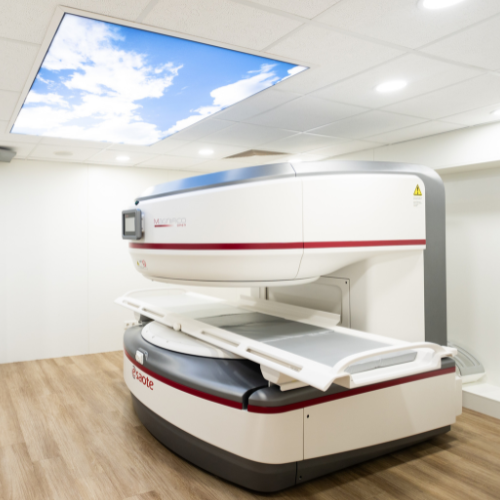
The open MRI scanner near Munich at the ROC Regenerative Center in Aschheim is suitable for orthopedic examinations of the spine, joints, and soft tissues. The open design offers more space than a traditional MRI tunnel. This can make the examination significantly easier, especially for people with a fear of enclosed spaces or claustrophobia.
Whether it’s back pain, a suspected meniscus tear, shoulder pain, or a possible herniated disc: an MRI image alone isn’t enough for an assessment. At ROC, we review the images along with your symptoms, any previous findings, and the results of your physical examination. Based on this information, we can determine whether treatment is necessary and what options are available.
Since January 2023, the open MRI has been available directly at the ROC in Aschheim. This allows orthopedic imaging to be performed at the same location where the medical examination and, if necessary, further treatment take place.
Open-plan design
More space than in a traditional, narrow MRI tube
Without X-rays
Imaging Using Magnetic Fields and Radio Waves

Orthopedic Classification
MRI images are evaluated in conjunction with the patient's symptoms and physical examination
What is an open MRI?
Magnetic resonance imaging, or MRI for short, produces detailed cross-sectional images of the body’s interior. It is particularly effective at visualizing many soft tissue structures, including intervertebral discs, menisci, tendons, muscles, ligaments, and nerve tissue. For many orthopedic conditions, MRI provides additional information when the cause cannot be sufficiently determined through a physical examination alone.
Unlike X-rays, an MRI scan does not use ionizing X-ray radiation. The images are created using magnetic fields and radio waves.
The MRI system at the ROC features an open design. This provides more space during the exam than a traditional, narrow tunnel. This can be particularly beneficial for patients with claustrophobia, limited mobility, or pain associated with lying down for extended periods.
Open MRI for patients with anxiety and people with claustrophobia
An MRI appointment can be stressful for people with agoraphobia or claustrophobia. The narrow tube of a conventional MRI machine, in particular, triggers severe anxiety in some patients. As a result, some have found previous exams to be extremely stressful or have even had to stop them early.
The open MRI scanner at the ROC offers more space, which can make the exam more comfortable. If you already know that confined spaces cause you problems or if you have had to stop an MRI exam in the past due to claustrophobia, please mention this when you make your appointment. The team can discuss the procedure with you in advance and accommodate your situation.
Pain or limited mobility can also make it difficult to lie still for an extended period. Before the scan, we will therefore determine which position is necessary for the area being examined and which position you can maintain as comfortably as possible. It is important to lie still so that the images can be properly evaluated.
For which conditions is open MRI used?
The ROC focuses on orthopedic issues. The appropriate examination depends on your symptoms and which structures need to be examined.
- Spine: for example, in cases of suspected herniated disc, disc degeneration, or other structural causes of back pain
- Knee: including possible meniscus, cruciate ligament, or cartilage injuries
- Shoulder: if injuries or abnormalities of tendons and other soft tissues are suspected
- Other Joints: Examination of the hip, elbow, ankle, or wrist when medically indicated
- Sports Injuries: Assessment of Ligaments, Tendons, Joints, and Other Soft Tissue Structures Following an Injury
- Persistent, unexplained symptoms: further evaluation if the cause of pain or limited mobility has not yet been clearly determined
Which diagnostic method is appropriate for your symptoms?
Not every orthopedic issue can be addressed using the same imaging modality. MRI is particularly well-suited for visualizing many soft tissues. Depending on which structures are to be examined, other or complementary imaging modalities may be more appropriate.
Open MRI
4D Spinal Measurement
Digital Volume Tomogram (DVT)
Sonography
For a complete overview of the various procedures, see " Orthopedic Diagnostics at the ROC."
Benefits of Open MRI in Aschheim
- More space: The open design can be more comfortable than a traditional, narrow MRI tube, especially for people with agoraphobia or claustrophobia.
- No ionizing X-rays: MRI images are created using magnetic fields and radio waves.
- Orthopedic Focus: This procedure is suitable for many examinations of the spine, joints, tendons, and other soft tissues.
- Medical Interpretation: The images will be evaluated in conjunction with your symptoms, previous findings, and the physical examination.
- Further Diagnostics on Site: If additional information is needed, the ROC offers additional orthopedic diagnostic procedures.
- On-site treatment: If the diagnosis leads to a treatment plan, appropriate next steps can be discussed directly at the ROC.
Here's how an open MRI scan works
Before the exam, we will determine which area of the body needs to be examined and what needs to be assessed based on the images. Please bring any existing doctor’s notes as well as previous MRI, CT, or X-ray images to your appointment, if possible. This will allow us to take any previously known findings into account and avoid unnecessary duplicate exams.
Before the procedure begins, please remove any metal objects that do not belong in the examination area. You will then be positioned according to the specific body region being examined. Please let the team know if a particular position causes you pain or if you feel uneasy due to claustrophobia. During the scan, please lie as still as possible. The machine produces the tapping and clicking sounds typical of an MRI exam. The scan usually takes about 20 to 30 minutes, but this can vary depending on the body region and the scope of the examination. Afterward, the images are evaluated by a doctor and compared with your symptoms and the examination results. A visible finding does not necessarily explain the cause of pain or limited mobility. Therefore, the overall picture is what matters for further treatment.
How does a 17-metric-ton MRI scanner get into the ROC?
Bringing the open MRI scanner into the ROC was also a special logistical challenge. The device, which weighs about 17 metric tons, was transported to Aschheim in 2023 and installed on site. We show how the transport and installation of the MRI scanner went in our blog.
The History of Open MRI at the ROC
Pacemakers, defibrillators, and other implants
Implants must be taken into account before every MRI exam. Therefore, please inform the team about any pacemakers, implanted defibrillators, or other medical implants when you schedule your appointment. You should bring any implant identification cards with you to your appointment.
From MRI Findings to Further Treatment
An MRI can reveal changes in anatomical structures. However, whether these changes are actually causing your symptoms and what treatment is appropriate can only be determined in a medical context.
A finding related to an intervertebral disc, for example, may be relevant, but it is not necessarily the cause of your current back pain. The same applies to changes in the meniscus, cartilage, or tendons. That is why, at the ROC, we evaluate the imaging results, your symptoms, and the physical examination together.
For certain spinal conditions, MRI imaging can also be used to precisely guide treatment. In MRI-guided PRT, it is used to accurately monitor the position during an infiltration near a nerve. For more information, see “Spinal Therapy at the ROC.”
Costs for an Open MRI
The cost of an MRI exam depends, among other things, on the body region being examined and the scope of the exam.
ROC Ortho is a private practice. Before scheduling an appointment, you can find out what the estimated cost of your examination will be. Whether and to what extent private health insurance or a health allowance will cover the costs depends on the terms of your respective policy. If you have public health insurance, you should inquire before your appointment about the conditions under which you can receive an examination as a self-pay patient.
MRI Diagnostics at the ROC in Aschheim
The Medical Team

Dr. med. Daniel Filesch
Specialist in orthopaedics and trauma surgery

Martina Berger
Doctor for regenerative orthopaedic procedures

Dr. med. Edan Manos
Doctor for regenerative orthopaedic procedures

Patrick Heine
Specialist in orthopaedics and trauma surgery
Modern office space

ROC Ortho
Private Orthopedic Practice
St.-Emmeram-Str. 5
85609 Aschheim
Email: praxis@roc-ortho.de
Phone: +49 89 46259930
Opening hours
| Monday | 7:30 a.m. – 6:00 p.m. |
| Tuesday | 7:30 a.m. – 6:00 p.m. |
| Wednesday | 7:30 a.m. – 8:00 p.m. |
| Thursday | 7:30 a.m. – 6:00 p.m. |
| Friday | 7:30 a.m. – 2:00 p.m. |