Open MRI
For many people, an MRI scan is associated with a narrow tube and an uncomfortable feeling. That’s why we offer an open MRI at ROC. The machine is open on the sides, providing more space during the scan.
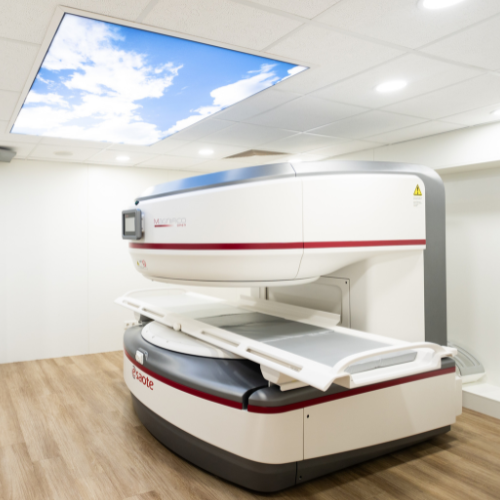
Our open MRI scanner is located right next to the ROC in Aschheim. This allows us to closely integrate imaging with our orthopedic diagnostics. Your symptoms, the results of the physical examination, and the MRI images can be reviewed together and medically interpreted.
We offer MRI exams for privately insured patients and self-pay patients.
What is an MRI used for?
Magnetic resonance imaging, or MRI for short, provides detailed cross-sectional images of the body. It is particularly effective for evaluating many soft tissue structures, such as muscles, tendons, ligaments, intervertebral discs, nerves, and cartilage.
Common orthopedic issues include, for example:
- Meniscus or cartilage damage in the knee
- Herniated discs and other spinal conditions
- Tendon tears or tendon irritation in the shoulder
- Ligament and Muscle Injuries
- Joint inflammation and joint effusions
- Pain in the hip, ankle, foot, or hand
- Persistent symptoms following injuries or surgeries
- Follow-up Examinations for Pre-existing Conditions
An MRI isn't necessary for every complaint. We therefore assess which type of imaging is appropriate for your specific condition and whether our open MRI is suitable for that purpose.
Open-plan design
More space than in a traditional, narrow MRI tube
Without X-rays
Imaging Using Magnetic Fields and Radio Waves

Orthopedic Classification
MRI images are evaluated in conjunction with the patient's symptoms and physical examination
Which areas of the body can we examine?
Our open MRI scanner in Aschheim can be used to examine the following body regions, among others:
- Cervical Spine
- Thoracic spine
- Lumbar spine
- Shoulder
- Elbow
- Arm
- Hand and Wrist
- Finger
- Pelvis and Hips
- Leg
- Knee
- Ankle joint
- Foot and Toes
Not every medical question can be answered equally well with every MRI system. That is why our team determines, before scheduling an appointment, whether the requested examination can be performed using our equipment.
What makes our open MRI special?
In a conventional MRI scan, the patient usually lies inside a relatively narrow tube. Our Magnifico Open, on the other hand, is open on the sides.
This can be particularly helpful for:
- People who suffer from claustrophobia or feel uncomfortable in confined spaces
- Children
- older patients
- People with limited mobility
- People who have already had unpleasant experiences in a closed MRI scanner
The easily accessible examination table and the coils, which are tailored to the specific body region, make positioning easier. The open design can help make the examination feel less confining.
However, the experience of an MRI scan varies from person to person. If you suffer from severe claustrophobia, please let our team know when you schedule your appointment.
How does an MRI scan work?
Magnetic resonance imaging (MRI) uses a strong magnetic field and high-frequency electromagnetic fields. Unlike X-rays or computed tomography (CT), it does not involve the use of ionizing X-ray radiation. During the examination, cross-sectional images of the relevant body region are generated. These can then be viewed from different angles and evaluated by a physician. Even though no X-ray radiation is used, certain safety precautions must be observed. Implants, electronic devices, and metal objects in or on the body must therefore be carefully assessed before the examination.
Here's How Your MRI Exam Will Go at Our Facility
Before the examination, we will discuss with you which area of the body should be examined and whether any implants, previous surgeries, or other medical conditions need to be taken into account.
Please bring any MRI, CT, or X-ray images, medical reports, surgical reports, implant cards, and a current list of medications with you. This will allow us to take existing findings into account during planning and evaluation.
Before entering the MRI room, you must remove all metal and electronic objects. These include, for example, jewelry, watches, hearing aids, keys, cell phones, and clothing with large metal parts. Our team will then position you on the examination table. The appropriate examination coil will be placed over the relevant body region. During the scan, you should lie as still as possible to ensure that clear images are obtained. Depending on the body region and the medical issue being investigated, the exam usually takes about 20 to 30 minutes. In some cases, the duration of the exam may vary. After the exam, the images are evaluated by a physician. Our team will let you know when and how you will receive your results and images.
Open MRI for anxious patients and people with claustrophobia
An MRI appointment can be stressful for people with claustrophobia (commonly known as a fear of enclosed spaces). The narrow tube of a traditional MRI machine, in particular, triggers severe anxiety in some patients. As a result, some have found previous exams extremely stressful or have even had to stop them.
Our open MRI scanner at the ROC offers more space, which can make the exam more comfortable. If you already know that confined spaces cause you problems or if you’ve had to stop an MRI exam in the past due to claustrophobia, please mention this when you schedule your appointment. The team can discuss the procedure with you in advance and accommodate your situation.
Pain or limited mobility can also make it difficult to lie still for an extended period. Before the scan, we will therefore determine which position is necessary for the area being examined and which position you can maintain as comfortably as possible. It is important to lie still so that the images can be properly evaluated.
Open MRI for Children
The open design can also make the MRI exam easier for children. After the appropriate safety checks have been completed, a parent may remain in the room during the exam. Upon request, we can play music or an audio story. Our team explains the procedure in simple terms and takes the time to ensure your child understands what will happen during the exam. To ensure clear images, it’s important that the child lies as still as possible during the exam. We’ll discuss with you in advance whether the exam is likely to be feasible.
MRI After Surgery
Even after surgery involving metal implants, an MRI scan may generally still be possible. Whether the implant is suitable for an MRI and whether sufficient image quality can be achieved in the affected area of the body must always be assessed on a case-by-case basis. Metal can cause image artifacts and limit the ability to evaluate adjacent structures. The severity of these so-called artifacts depends, among other factors, on the material, the location of the implant, and the region being examined. Please let us know what type of surgery you underwent when you schedule your appointment. Please bring any implant cards and surgical reports with you to the examination.
MRI with Implants and Medical Devices
Whether an MRI scan can be performed with an implant or medical device depends on the specific model, the components used, and the planned examination.
When scheduling an appointment, please let us know the following:
- Pacemakers or implantable defibrillators
- Neurostimulators
- Medication Pumps
- Cochlear Implants
- Vascular clips or stents
- Joint replacements and other orthopedic implants
- Metal parts or foreign objects in the body
Please bring any existing implant cards and surgical reports with you. Without clear information about the implant, it may not be possible to perform the required safety check.
Physical Requirements for the Examination
The distance between the coils in our open MRI scanner is about 80 centimeters. Therefore, if a patient has a very large body circumference, it may not be possible to perform the examination.
If you're unsure whether our machine is right for you, please let us know when you request an appointment. Our MRI team will be happy to discuss the requirements with you in advance.
Schedule an appointment in Aschheim
ROC Ortho
Private Orthopedic Practice
St.-Emmeram-Str. 5
85609 Aschheim
Email: praxis@roc-ortho.de
Phone: +49 89 46259930
Opening hours
| Monday | 7:30 a.m. – 6:00 p.m. |
| Tuesday | 7:30 a.m. – 6:00 p.m. |
| Wednesday | 7:30 a.m. – 8:00 p.m. |
| Thursday | 7:30 a.m. – 6:00 p.m. |
| Friday | 7:30 a.m. – 3:00 p.m. |

Read the story of how the 17-ton MRI machine moved into the ROC here: To the blog post.
For referring doctors
Primary care and specialist practices can refer their patients to our Open MRT in Aschheim for an MRI exam. To ensure targeted exam planning, we ask that you provide a clear clinical presentation as well as relevant previous findings, surgical reports, and information about any existing implants. The findings and images will be made available to the referring practice in accordance with data protection regulations. Information regarding scheduling and the organizational process can be obtained directly from Open MRT Aschheim.