Guide | July 2, 2026
Tennis Elbow Treatment: What Really Helps with Elbow Pain
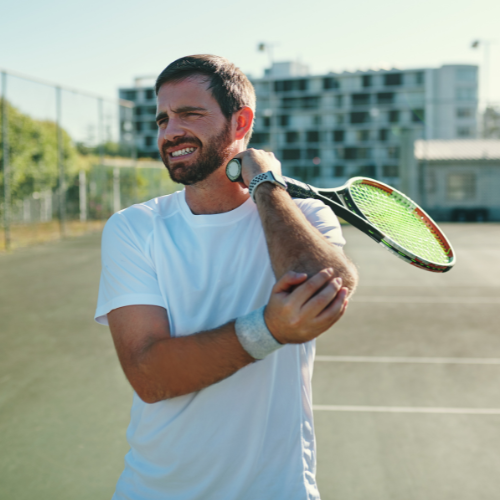
Successful treatment of tennis elbow begins with an accurate diagnosis. Not every type of elbow pain is automatically tennis elbow. Often, the symptoms are caused by an irritated or overused tendon insertion, but sometimes nerves, joints, muscles, or the cervical spine are also involved. For tennis elbow treatment to be successful in the long term, the actual cause of your symptoms must first be identified.
The name “tennis elbow” is often misleading. Most patients who come to us with tennis elbow have never played tennis. Instead, tennis elbow symptoms are often caused by repetitive strain in daily life or at work—for example, from working on a computer, doing manual labor, gardening, strength training, or regularly lifting and carrying heavy objects.
A typical symptom of tennis elbow is pain in the elbow that starts on the outside and may radiate down into the forearm. Many people first notice the symptoms of tennis elbow when shaking hands, opening a screw-top jar, carrying a shopping bag, or lifting a coffee cup. Over time, even everyday movements can lead to significant elbow pain.
At the ROC Regenerative Center in Aschheim near Munich, we do not view tennis elbow in isolation as a localized tendon problem. Often, shoulder function, mobility of the cervical spine, muscle tension, workplace ergonomics, or athletic strain also play an important role. That is why every tennis elbow treatment at our center begins with a thorough analysis of all contributing factors and possible causes.
What is tennis elbow?
Tennis elbow, medically known as lateral epicondylopathy or epicondylitis, affects the tendon insertions of the forearm muscles on the outside of the elbow. The insertions of the wrist extensors are particularly commonly affected, as they are strained during nearly every gripping, lifting, or twisting movement.
In the past, tennis elbow was primarily viewed as an inflammation. Today, we know that in cases of long-standing tennis elbow symptoms, structural changes in the tendon are usually the main factor. The tendon loses its resilience, becomes more sensitive to stress, and regenerates more slowly.
That is precisely why simply resting the affected area often provides only short-term relief for tennis elbow. While the pain in the elbow may temporarily subside, this does not improve the tissue’s resilience. The goal of modern tennis elbow treatment is therefore to reduce pain while simultaneously restoring the tendon’s function and resilience over the long term.
Tennis Elbow Symptoms: Recognizing Typical Symptoms
The symptoms of tennis elbow often develop gradually. At first, the symptoms usually occur only after physical exertion. As the condition progresses, even everyday movements can cause pain.
Typical symptoms of tennis elbow include:
- Pain on the outside of the elbow
- Pain on pressure at the outer bony protrusion
- Radiation of the pain into the forearm
- Pain when grasping, lifting, or twisting
- Pain when opening bottles or doors
- Loss of strength in a handshake
- Discomforts When Using a Mouse and Keyboard
- Pain During Strength Training, Tennis, or Padel
- Morning stiffness or pain upon initial movement after periods of rest
Many patients also report that they drop objects more often or find certain movements suddenly much more difficult than they used to be.
However, not every case of elbow pain is tennis elbow. If you also experience numbness, tingling, swelling, severe limitation of movement, or pronounced nighttime pain, the cause should be investigated more thoroughly. Drom or rheumatic diseases can trigger similar symptoms. An accurate diagnosis is therefore crucial.
Why the Right Diagnosis Is Crucial
Many people with this condition have already worn a tennis elbow brace, tried ointments, done tennis elbow exercises, or taken pain relievers before seeking an orthopedic examination. Often, the symptoms improve at first but return when the arm is strained.
The reason: Elbow pain can have various causes. In addition to tennis elbow, other possible causes include bursitis, nerve irritation, problems with the cervical spine, shoulder issues, or joint changes.
That is why every tennis elbow treatment at the ROC begins with a thorough evaluation. We not only examine the painful area on the elbow, but also assess the entire kinetic chain, including the shoulder, cervical spine, forearm, and wrist.
Only by identifying the actual cause can the appropriate treatment for tennis elbow be planned. An accurate diagnosis is the foundation of any successful tennis elbow treatment and helps prevent unnecessary therapies or prolonged symptoms.
Ultrasound, MRI, and Other Diagnostic Tests for Tennis Elbow
Successful treatment for tennis elbow begins with an accurate diagnosis. The better we understand why your tennis elbow symptoms have developed, the more precisely we can select the appropriate treatment.
Ultrasound is one of the most important diagnostic tools for many patients with tennis arm or tennis elbow. Using ultrasound, we can directly assess tendons, bursa, muscles, and soft tissues. At the same time, we can examine the affected structures while the patient is moving. This often allows us to identify the typical changes associated with tennis arm as early as the first examination.
If elbow pain has persisted for a long time, if symptoms do not improve despite treatment, or if there is suspicion of more severe tendon damage, an MRI may also be recommended. Our open MRI in Aschheim provides detailed images of tendons, muscles, ligaments, and joint structures. This allows us not only to assess tennis elbow more accurately but also to rule out other causes of elbow pain.
If tingling, sensory disturbances, or weakness also occur, we will assess whether nerve involvement is a possibility. In these cases, electrophysiological tests, such as an EMG, can provide important insights. In certain situations, laboratory tests supplement the diagnostic process—for example, when inflammatory conditions or metabolic disorders might be contributing to the symptoms.
For us, the focus isn’t just on the diagnosis of “tennis elbow.” What matters most is why your symptoms developed and what factors might be hindering your recovery. That’s why we look not only at the painful area around the elbow, but also at the shoulder, cervical spine, wrist, work-related stress, and athletic activities.
The better we understand the cause of your tennis elbow symptoms, the more effectively we can tailor your tennis elbow treatment. Our goal is not just to reduce pain in the short term, but to achieve a lasting improvement in your ability to handle physical stress so that you can resume your daily activities, your job, and your sports as pain-free as possible.
Tennis Elbow Treatment Without Surgery: What Are the Options?
The good news is that most patients with tennis elbow do not need surgery. In many cases, tennis elbow can be successfully treated without surgery if the cause of the symptoms is identified and the treatment is consistently tailored to the individual’s specific symptoms.
Modern treatment for tennis elbow rarely consists of just a single approach. Instead, we combine various therapeutic components to reduce elbow pain, restore the strength of the irritated tendon, and prevent relapses.
At the ROC Regenerative Center, we don’t just focus on tennis elbow itself. We also take into account the workplace, sports, movement patterns, shoulder function, the cervical spine, and everyday stressors when planning treatment. Often, small changes can make the difference between whether an irritated tendon heals completely or continues to cause recurring tennis elbow symptoms.
Depending on the diagnosis, your personalized tennis elbow treatment may include the following measures:
| Action | When it can be useful |
| Load Adjustment | For acute tennis elbow symptoms and painful everyday movements |
| Physiotherapy | To improve flexibility, strength, and endurance |
| Tennis Elbow Exercises | For the targeted development of tendon strength |
| Tennis Elbow Brace | Temporary, during sports or physical activity |
| Shock Wave Therapy for Tennis Elbow | For chronic tendinopathy |
| PRP or Autologous Blood Therapy | In cases of chronic conditions and impaired healing |
| Infiltrations | In select cases to support treatment |
| Operation | Only rarely in cases of persistent symptoms despite exhaustive treatment |
The best treatment for tennis elbow depends on many factors. Key considerations include the duration of your symptoms, the intensity of the pain in your elbow, the physical demands of your job and sports activities, and any treatments you have already undergone.
That is why we create a personalized treatment plan for each patient. Our goal is not merely to provide short-term relief from symptoms. Successful treatment of tennis elbow should identify the cause of the overuse, improve the tendon’s long-term resilience, and enable you to return to your daily life, work, and sports.
Acute Tennis Elbow Treatment: What's Important in the First Few Weeks
Treatment for acute tennis elbow has one primary goal: to soothe the irritated tendon without further weakening its resilience. This is exactly where many people make a common mistake. Either they ignore the pain and continue to put strain on the arm as before, or they completely rest the affected side.
In cases of tennis elbow, neither of these approaches often leads to the desired results. The tendon needs sufficient rest, but at the same time, it also requires controlled movement to maintain strength, flexibility, and resilience.
If you are experiencing acute tennis elbow symptoms, you should reduce activities that trigger the typical pain. These often include:
- Heavy lifting with an outstretched arm
- repeated rotational movements of the forearm
- High-intensity strength training
- Prolonged use of a mouse and keyboard
- manual tasks requiring a strong grip
- Gardening or frequent use of tools
Many patients find cold therapy pleasant after exercise. Heat therapy can be helpful if there is additional tension in the forearm, shoulder, or neck muscles.
Anti-inflammatory ointments or pain relievers can temporarily relieve tennis elbow symptoms. However, they are not a substitute for treatment that addresses the underlying cause of tennis elbow. If elbow pain persists for several weeks or recurs repeatedly, the cause should be evaluated by an orthopedist.
Tennis Elbow Exercises: Why the Right Amount Is Key
Targeted tennis elbow exercises are among the most important components of successful tennis elbow treatment. The goal is to gradually rebuild the strength of the irritated tendon and prevent the symptoms from returning.
Keep in mind: Not every exercise is helpful during every stage of tennis elbow. Tennis elbow stretching exercises that are too intense or building strength too quickly can actually make the symptoms worse.
Controlled stretching exercises for the forearm muscles, as well as eccentric training methods, have proven particularly effective. In these exercises, the muscles work in a controlled manner against resistance, specifically targeting the tendon structure.
It is important that the tennis elbow exercises are appropriate for the current stage of your symptoms. A slight pulling sensation during the exercise is usually not a problem. However, sharp pain or a noticeable worsening of symptoms the next day may indicate that the strain is too great.
In our physical therapy practice, we develop personalized exercise programs for patients with tennis elbow, tailored to their occupation, sports activities, and recovery process.
Tennis Elbow Brace: When It's Recommended
Many people with tennis elbow wonder if a tennis elbow brace really helps. The answer is: Yes, but not as a standalone solution.
A tennis elbow brace can reduce the tension on the irritated tendon insertion, thereby alleviating discomfort during work, sports, or daily activities. Many patients report noticeable relief, especially when dealing with recurring strain.
However, it is important to use it correctly. The bandage is worn a few centimeters below the elbow and should be neither too loose nor too tight.
However, a tennis elbow brace does not treat the underlying cause of the pain. If you need to wear the brace long-term to be able to work or play sports without pain, the cause of your tennis elbow should be investigated further.
How do you sleep with tennis elbow?
Many patients notice their tennis elbow symptoms especially at night or right after getting out of bed. This is often because the arm is positioned awkwardly during sleep or because pressure is placed on the irritated tendon insertion.
It may be helpful to rest your forearm on a pillow and avoid direct pressure on the outside of your elbow. If you sleep on your side, be careful not to trap the affected arm under your body.
If you experience severe pain, tingling, or numbness at night, you should have the diagnosis reviewed. Not every case of nighttime elbow pain is automatically tennis elbow.
Tennis Elbow Bandages, Ointments, and Home Remedies: What They Can Do
Many people with this condition initially look for ways to treat tennis elbow at home. Bandages, ointments, and home remedies can indeed provide temporary relief. However, their effectiveness is limited.
A tennis elbow brace can relieve pressure on the tendon attachment. Anti-inflammatory ointments or cooling gels can reduce pain in the elbow. Home remedies such as cold compresses, heat, or quark wraps are often found to be soothing.
However, these measures are usually not enough to ensure a long-term recovery from tennis elbow. The key is targeted load management, appropriate tennis elbow exercises, and treatment of any underlying causes.
Regenerative Tennis Elbow Therapy at the ROC
If tennis elbow symptoms persist for months or keep recurring despite physical therapy and adjustments to physical activity levels, regenerative treatments can be a useful addition to tennis elbow treatment.
Shock Wave Therapy for Tennis Elbow
Shock wave therapy for tennis elbow is one of the established treatments for chronic tendinopathy. In this procedure, targeted mechanical impulses are transmitted to the affected tissue.
The goal of shock wave therapy is to improve blood flow, stimulate metabolic processes, and support tendon regeneration. It can be a useful complement to physical therapy and exercise rehabilitation, especially for long-standing tennis elbow symptoms.
PRP and Autologous Blood Therapy for Tennis Elbow
Another option for regenerative treatment of tennis elbow is PRP therapy. In this procedure, a concentrate rich in platelets and growth factors is extracted from your own blood.
This plasma is precisely delivered to the damaged tendon attachment site. The goal is to support the body's natural healing processes and stimulate tissue regeneration.
It is important to have realistic expectations. Even PRP treatment for tennis elbow is no substitute for activity management or physical therapy. However, in certain chronic cases, it can be a useful component of a comprehensive treatment plan.
Infiltrations and Pain Management
In certain situations, injections can help reduce pain and create better conditions for active treatment.
The appropriate type of injection depends on the cause, stage, and symptoms. Especially in cases of chronic tendon problems, we carefully weigh the benefits against the potential drawbacks. Our goal is not short-term pain relief, but rather a lasting improvement in the elbow’s function and resilience.