
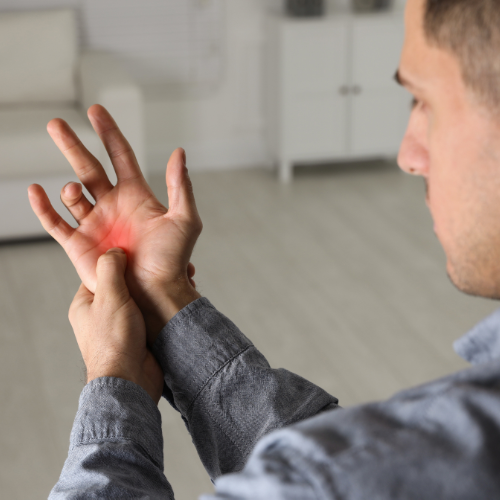
A snap finger or carpal tunnel syndrome can cause pain and significantly limit the mobility and function of the hand in everyday life. If conservative treatments are not sufficiently effective and surgical decompression becomes necessary, a traditional surgical incision is not always required.
At the ROC in Aschheim near Munich, we offer Spirecut® , an ultrasound-guided, minimally invasive procedure for treating trigger finger and carpal tunnel syndrome. The procedure is performed on an outpatient basis under local anesthesia through a small skin incision—without a traditional surgical incision and without stitches.
Spirecut® is a minimally invasive procedure for treating certain conditions involving restricted movement in the hand. These include, in particular, trigger finger—also known as snapping finger—and carpal tunnel syndrome.
The procedure involves the use of specially designed instruments that are inserted through a small incision in the skin. The treating physician monitors the instrument and the surrounding anatomical structures during the procedure using high-resolution ultrasound imaging.
This allows for targeted relief of the structure responsible for the constriction without the need for a traditional surgical incision.
At ROC, we use Spirecut® primarily to treat two common hand conditions:
In trigger finger, the flexor tendon can no longer glide freely through the so-called A1 ligament. Typical symptoms include the finger catching or snapping, pain, and, in some cases, increasing limitation of movement.
If conservative treatment options are not sufficiently effective, surgical division of the annular ligament may be necessary.
In the Spirecut® procedure, the constricting A1 ring ligament is cut using a minimally invasive technique under ultrasound guidance. This is intended to allow the flexor tendon to glide freely again.
Carpal tunnel syndrome is caused by compression of the median nerve in the wrist area. Typical symptoms include tingling and numbness, particularly in the thumb, index finger, and middle finger. These symptoms often occur at night. In advanced cases, pain, loss of strength, or impaired hand function may also occur.
If surgical decompression is necessary, the carpal ligament is cut to reduce pressure on the median nerve.
With Spirecut®, this decompression can be performed under ultrasound guidance through a small incision in the skin.
The key component of the procedure is continuous ultrasound guidance. Important anatomical structures of the hand can be visualized before and during the procedure.
The specially designed instrument is then inserted through a small incision and guided to the target structure under ultrasound guidance.
In trigger finger surgery, the constricting A1 ligament is cut. In carpal tunnel syndrome, the median nerve is relieved by cutting the carpal ligament.
Since no traditional skin incision is required, a skin suture is generally not necessary either.
Every treatment begins with a thorough examination. We’ll discuss your symptoms, examine the affected hand, and determine whether you have trigger finger or carpal tunnel syndrome.
In cases of carpal tunnel syndrome, depending on the findings, additional neurological testing or measurement of nerve conduction velocity may be advisable.
Not every case of trigger finger or carpal tunnel syndrome requires surgery. Depending on the stage, duration, and severity of your symptoms, as well as any previous treatments, we will discuss the appropriate treatment options with you.
If surgical intervention is indicated, we will assess whether the minimally invasive Spirecut® procedure is an option based on your individual findings.
The procedure is performed on an outpatient basis under local anesthesia. General anesthesia is generally not required for this procedure.
Under continuous ultrasound guidance, the instrument is inserted through a small incision in the skin. The affected structure is specifically relieved of pressure.
Since no traditional skin incision or sutures are required, the wound area is very small. When you will be able to put your full weight on your hand again depends on your individual condition and the nature of your activities. We will provide you with specific recommendations for the period following the procedure.
For both trigger finger and carpal tunnel syndrome, the goal of surgical treatment is to relieve pressure on the constricted structure. The main difference lies in the surgical approach.
In traditional open surgery, the procedure is performed through an incision in the skin. With Spirecut®, the instrument is inserted through a small skin opening and guided under continuous ultrasound guidance. This eliminates the need for a traditional skin incision and subsequent suturing.
Which method is appropriate in each individual case depends on the diagnosis, the test results, and other medical factors.

No traditional skin incision
The instrument is inserted through a small opening in the skin. A larger incision is not necessary.

Real-time Ultrasound Monitoring
The entire procedure is performed under continuous ultrasound guidance.

Local anesthesia
The procedure can be performed under local anesthesia. General anesthesia is not necessary.
Outpatient Treatment
The procedure is performed on an outpatient basis at the ROC in Aschheim.
No skin sutures
Because of the small incision, no traditional skin suture is required.
Quick return to everyday life
The hand is back to normal faster than it would be after surgery.
The ROC is one of the first facilities in Germany to have used the Spirecut® procedure for the minimally invasive treatment of trigger finger and carpal tunnel syndrome.
Our specialists combine ultrasound-guided treatment with thorough orthopedic diagnostics. The focus is not on the procedure itself, but on determining which treatment is medically appropriate for your specific condition.
If surgical intervention is necessary and Spirecut® is appropriate for your condition, the procedure can be performed on an outpatient basis right here at our facility in Aschheim.
Do you suffer from trigger finger, carpal tunnel syndrome, nighttime tingling, numbness, or pain in your hand? Contact us — we’d be happy to check whether Spirecut is right for you.
Phone: 089 46259930
E-mail: praxis@roc-ortho.de