Guide | June 3, 2026
Can trigger finger be treated without surgery?
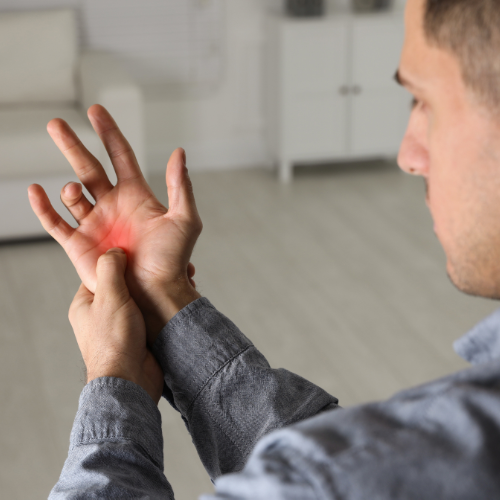
Successful treatment of trigger finger begins with an accurate diagnosis. Only once the cause, severity, and individual impact are known can the appropriate treatment be selected.
A trigger finger often feels harmless until the finger gets stuck in the morning, hurts when you try to grip something, or snaps forward with a noticeable jerk. Many people affected by this condition wait to see if it goes away on its own. Sometimes the symptoms improve, but often the irritation persists. As a result, the tightness at the A1 ligament can worsen, and range of motion can become increasingly limited.
At ROC Ortho in Aschheim near Munich, we approach trigger finger treatment from orthopedic, functional, and practical perspectives. Our goal is to reduce pain, improve tendon mobility, and work with you to find the most appropriate treatment option—ranging from conservative measures and injections to minimally invasive procedures such as Spirecut.
What Happens in the Hand When You Have Trigger Finger
The medical term for this condition is tendovaginosis stenosans, or trigger finger. It usually affects the flexor tendon of a finger or thumb. This tendon passes through narrow channels known as annular ligaments. The A1 annular ligament is located at the metacarpophalangeal joint, where the finger meets the palm.
If a constriction occurs due to overuse, metabolic disorders, or a localized thickening of the tendon, the tendon can no longer glide smoothly through the tendon sheath. Movement becomes increasingly difficult. When the finger is straightened or bent, tension builds until the constriction suddenly gives way. The finger then snaps abruptly into the desired position.
Common symptoms:
- Pain in the palm at the base of the finger
- morning stiffness
- Noticeable friction or a nodule over the flexor tendon
- Getting stuck when stretching or bending
- Snapping in the thumb, middle finger, or ring finger
- In advanced cases: a finger locked in a flexed or extended position
Treatment for trigger finger always depends on the stage of the condition. A mild rubbing of the tendon requires different measures than a finger that can only be released with the other hand.
Why the thumb, middle finger, and ring finger are often affected
Trigger finger in the thumb is often noticed early on because activities such as grasping, writing, typing, or opening jars constantly put strain on the thumb. Trigger finger in the middle finger is often noticeable when gripping firmly, such as during sports, while doing manual labor, when holding a steering wheel, or when carrying heavy objects. The ring finger is also a common site for this condition.
In most cases, the cause is not a single awkward movement. Often, the symptoms result from many small strains over a long period of time. Repeated forceful gripping, prolonged use of tools, gardening, strength training, or occupational activities that place significant strain on the hands can contribute to the development of these symptoms.
Therefore, when choosing the right treatment, it is not enough to simply examine the affected finger. It is also important to consider the activities that trigger the symptoms, the timeline of the symptoms, and any underlying medical conditions that may affect tendon function.
Causes of Trigger Finger: Mechanical Irritation, Metabolism, and Inflammation
Several factors usually contribute to trigger finger. Mechanical overuse is often the primary cause. At the same time, certain medical conditions can make tendons and connective tissue more sensitive to stress.
Known risk factors include:
- Diabetes mellitus: People with diabetes are more likely to develop tendon constrictions and snapping fingers.
- Thyroid Disorders: The search query “trigger finger and the thyroid” has a medical basis. Changes in metabolism can affect connective tissue and tendons.
- Rheumatic Diseases: Inflammatory processes can impair the tendons' ability to glide and promote irritation.
- Osteoarthritis and changes in the wrist joints: Altered movement patterns and stress patterns can contribute to symptoms.
- Occupational or sports-related strain on the hands: Repeated, forceful gripping, working with tools, gardening, or certain sports increase the strain on tendons and ligaments.
Trigger Finger and the Liver: A direct link has not yet been identified as a typical cause of trigger finger. However, if multiple tendon constrictions occur simultaneously or if other symptoms are present, a more thorough medical evaluation may be advisable.
Especially when multiple fingers are affected, the symptoms occur on both sides, or they keep recurring, it’s worth looking into possible metabolic disorders and comorbidities.
Diagnosis Before Trigger Finger Treatment: Look, Feel, Test
Successful treatment of trigger finger begins with a thorough diagnosis. Even a discussion of symptoms, activities that aggravate the condition, and how the condition has progressed over time provides important clues.
During the physical examination, we check, among other things:
- Pain on pressure in the area of the A1 annulus
- palpable thickening along the flexor tendon
- the extent of the restriction of movement
- the typical snapping or jamming of the finger
- the mobility of the entire hand
Tenderness on palpation of the A1 ligament often provides an important clue as to the cause of the symptoms.
In orthopedics, ultrasound can complement the diagnostic process when tendon thickening, signs of inflammation, or associated findings need to be assessed more precisely. For more complex symptoms, unexplained pain, or suspected additional causes , the ROC also offers modern imaging techniques such as digital X-rays and open MRI.
Accurate diagnosis helps in selecting the appropriate treatment and avoiding both unnecessary procedures and waiting too long.
Treating Trigger Finger Without Surgery: What Conservative Treatment Options Are Available?
Many people with this condition are looking for ways to treat trigger finger without surgery. That's understandable. Not every case of trigger finger requires immediate surgery.
Particularly in cases of mild to moderate symptoms, conservative treatment for trigger finger may be appropriate initially, provided there is no fixed lock.
Depending on the findings, these may include, among other things:
- Temporary Adjustment of Strenuous Tasks
- Avoiding repeated forceful gripping motions
- Intermittent power supply to the tracks, especially at night
- Anti-inflammatory measures as determined by a physician
- Targeted hand therapy or physical therapy
- Injections into the tendon sheath in cases of severe irritation or swelling
The appropriate treatment depends on the stage of the disease. While early-stage cases often respond well to conservative measures, recurrent episodes or advanced symptoms frequently require a different approach.
At ROC, we work with each individual to determine which therapy best suits their medical condition and their needs in daily life, at work, or in sports.
The ROC can provide appropriate complementary treatment through physical therapy, especially when movement patterns, hand function, or follow-up care are involved.
Trigger finger exercises: helpful when the finger isn't completely locked up
Many people with trigger finger look for exercises to relieve their symptoms on their own. Exercises can help improve mobility and relieve pressure on irritated tissue. However, they are no substitute for a medical diagnosis.
The prerequisite is that the finger is not permanently locked and that the exercises can be performed without pain.
Appropriate measures include, for example:
- Sliding exercises: Slowly straighten and gently bend your fingers without forcing them into a tight fist.
- Tendon mobilization: Assume various finger positions—such as the "table hand," "hook fist," and "loose fist"—one after another.
- Heat therapy: Warm hand baths can be soothing, especially in the morning when you feel stiff.
- Activity Log: Document which activities intensify or improve snapping.
The key is to get the intensity right. Exercises should neither cause pain nor make the snapping worse. The goal is to achieve as smooth a movement of the tendon as possible, rather than forcing it to stretch against resistance.
If symptoms or swelling worsen after the exercises, you should reduce the intensity and consult a doctor to determine the cause.
Treatment of Trigger Finger with Injections: When Is a Cortisone Shot an Option?
For certain types of trigger finger, an injection into the tendon sheath can help reduce swelling and irritation. Many patients are familiar with this treatment as a cortisone shot for trigger finger.
Whether an injection is appropriate depends on several factors. Among other things, the following are key:
- Extent of inflammation and swelling
- Duration of symptoms
- Frequency of blockages
- possible comorbidities such as diabetes mellitus
- previous treatments or injections
The goal of treatment is to reduce irritation in the area of the A1 ring ligament and improve the gliding motion of the tendon.
At ROC, we do not view injections as a standard treatment, but rather as part of an individualized treatment plan. In doing so, we carefully weigh the benefits, potential risks, and alternative treatment options against one another.
However, in cases of long-standing symptoms, pronounced mechanical blockages, or recurring problems following an injection , treatment focused solely on reducing inflammation is often insufficient. In these cases, the mechanical narrowing itself is the primary concern.
When is surgery for trigger finger recommended?
Surgical treatment may be considered if conservative measures do not produce the desired results or if the finger repeatedly locks, significantly limiting hand function.
In traditional trigger finger surgery, the A1 ligament is split through a small skin incision so that the tendon can slide freely again. The procedure is considered well-established and has been used successfully for many years.
However, as with any surgical procedure, patients may experience pain at the incision site, scarring, swelling, or a temporary limitation of hand function. For this reason, we carefully evaluate which treatment option is most appropriate for each individual’s situation before performing surgery.
Spirecut as an Alternative to Surgery for Trigger Finger
Spirecut is a minimally invasive procedure for the percutaneous division of the A1 annulus. “Percutaneous” means that access is gained through a very small incision in the skin. High-resolution ultrasound guides the procedure in real time. Specially designed instruments perform the division in a controlled manner, without a traditional skin incision and without sutures.
We offer the Spirecut treatment for trigger finger and carpal tunnel syndrome. As the first orthopedic practice in Germany to use Spirecut, we have already had a great deal of positive experience with it. For more background, see the article about the first practice in Germany to use Spirecut.
This trigger finger treatment is particularly appealing to patients whose jobs involve repetitive hand movements, those who are self-employed, those with aesthetic concerns, or those with little flexibility regarding time off work. The procedure takes just a few minutes at the ROC, is performed under local anesthesia, and does not require a traditional operating room.
How the Spirecut Snap Finger Treatment Is Performed at the ROC
We begin with a thorough examination. We determine whether you actually have trigger finger, how severe your symptoms are, and whether treatment with Spirecut is appropriate for your condition. Using ultrasound, we can precisely visualize the tendons, annular ligaments, and surrounding nerves and blood vessels.
If Spirecut is the appropriate treatment option, we first administer a local anesthetic. We then guide the specially designed instrument to the A1 ring ligament under continuous ultrasound guidance. The constriction is carefully released so that the tendon can glide freely again. No traditional incision or sutures are required.
After treatment, you can usually start moving your finger again fairly quickly. How quickly you can increase the amount of weight you put on it depends on your individual condition, the affected finger, and your daily or work-related needs.
We’ll continue to support you after the procedure and provide you with clear recommendations regarding physical activity, rest, and the healing process. This way, you’ll know exactly what to watch out for in the days following your treatment.
Comparison: conservative treatment, injection, traditional surgery, and Spirecut
| Procedure | Suitable for | Advantage | Restriction |
|---|---|---|---|
| Rest, Splint, Exercises | early symptoms without a definite blockage | non-invasive procedure | In the case of a mechanical bottleneck, this is often not sufficient in the long term |
| Injection | Irritation and swelling of the tendon sheath | anti-inflammatory approach | Relapses are possible; be aware of individual risks |
| Traditional Trigger Finger Surgery | Blockage, chronic course, treatment failure | established procedure | Skin incision, suturing, wound care, and potential scarring |
| Spirecut | Appropriate annular stenosis following diagnosis | minimally invasive, ultrasound-guided, without a traditional skin incision | Not every anatomical or inflammatory finding is suitable |
The best treatment for trigger finger doesn't come from a chart. It comes from a diagnosis tailored to your hand and your daily life.
What Matters for Your Hand After Treatment
After treatment for trigger finger, proper aftercare plays an important role in the healing process. A gradual and balanced return to activity is crucial: Resting the finger too much can limit mobility, while resuming activity too early or too intensely can irritate the tissue again. The appropriate measures depend on the chosen treatment.
After conservative treatment for trigger finger, the primary focus is on modifying movements that put strain on the joint. Following an injection, we work together to monitor whether the pain, swelling, and snapping subside and whether the hand’s function improves.
After a procedure—such as a Spirecut treatment or a traditional annuloplasty—the focus is on early mobilization, monitoring the healing process, and a gradual return to daily life, work, and athletic activities.
We'll guide you through the process with personalized recommendations and tailor your follow-up care to your specific findings and personal needs.
Since hand symptoms often do not occur in isolation, we also take into account possible comorbidities and other causes as needed. It is not uncommon for patients to also have carpal tunnel syndrome, changes in the thumb saddle joint, or other conditions affecting tendons, joints, and nerves. A comprehensive orthopedic evaluation helps identify these connections early on and treat them effectively.
When You Should See a Doctor About a Trigger Finger
See a doctor for a snapping finger if the finger gets stuck regularly, if pain in the base of the finger increases, or if the mobility of your hand is limited in daily life. Severe morning stiffness can also be a sign that the symptoms should be further evaluated.
Early screening is particularly important if there are additional risk factors or comorbidities, such as:
- Diabetes mellitus
- Thyroid Disorders
- rheumatic diseases
- several affected fingers
- Symptoms in both hands
Immediate action is needed if the finger becomes temporarily locked, can only be released with the other hand, or if numbness also occurs. In these cases, the cause should be determined promptly, and a personalized treatment plan for trigger finger should be developed.
At the ROC Regenerative Center in Aschheim near Munich, we combine modern orthopedic diagnostics, high-resolution imaging, and personalized treatment plans. You can find directions here.
Depending on the findings, conservative treatments, injection therapies, or minimally invasive procedures such as Spirecut may be considered.
If your finger snaps when you bend or straighten it, gets stuck regularly, or causes pain, an early examination can help you find the right treatment and prevent your symptoms from getting worse.
Why We Look at More Than Just the Finger When Treating Trigger Finger
For us, successful treatment of trigger finger doesn’t begin with therapy, but with understanding the cause. That’s why we look not only at the narrowing of the A1 ligament, but also at the function of the entire hand, possible comorbidities, occupational stressors, and your individual needs in everyday life.
The ROC Regenerative Center combines modern orthopedic diagnostics with a focus on minimally invasive and functional treatment approaches. Using ultrasound, digital X-rays, and MRI, we can accurately diagnose symptoms and select the appropriate treatment.
Not every trigger finger requires the same treatment plan. Depending on the diagnosis, conservative measures, injection therapy, Spirecut treatment, or other hand surgery procedures may be appropriate. For us, the key factor is not a specific procedure, but rather the solution that best addresses your symptoms.
Many patients want a treatment that can be easily integrated into their work, family life, sports, and daily routine. That is precisely why we place great importance on personalized consultations, thorough diagnostics, and treatment decisions that take into account not just the finger, but the function of the entire hand.