Guide | December 23, 2025
New at ROC Derma in Aschheim: NanoStar® R laser for tattoo and pigment spot removal
The skin is our largest organ and reflects both our health and our lifestyle. As we age or as a result of sun exposure, changes can occur that affect the appearance of our skin. Tattoos, too, can go out of style over time or prove to be a hindrance in our personal lives or professional routines. This can lead to a desire to have the tattoo removed.
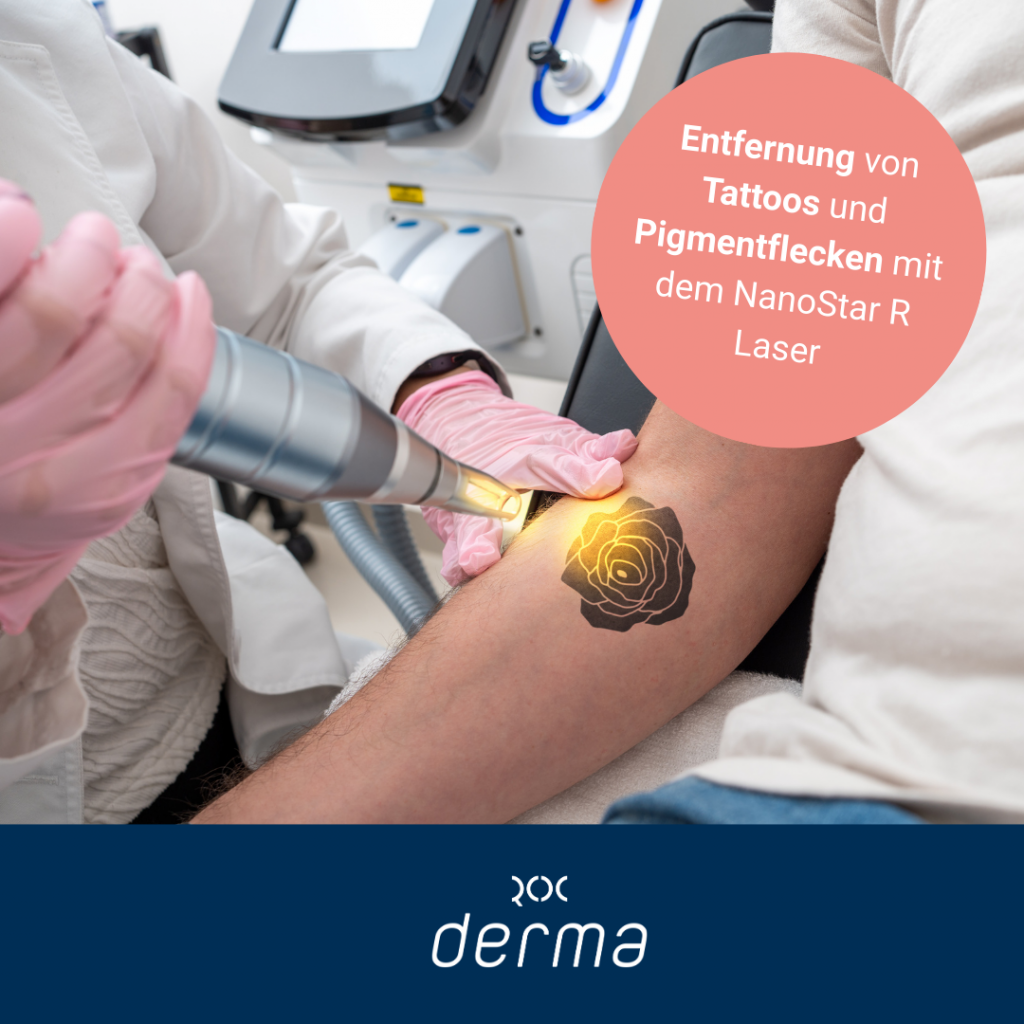
At ROC Derma, your private dermatology practice in Aschheim near Munich, the focus is on aesthetic and medical skin care of the highest standard. With the introduction of the NanoStar® R laser, the practice is expanding its range of services to include state-of-the-art laser therapy that enables the effective, precise, and gentle treatment of tattoos and pigmented skin lesions. The system complements ROC Derma’s existing offerings and sets new standards in skin treatment, as it is both medically sound and patient-friendly.
In this in-depth article, you'll learn everything about how the NanoStar® R laser works, its applications for tattoos and pigmented lesions, the treatment process, aftercare, potential risks, and the scientific background.
The Technology Behind the NanoStar® R Laser
The NanoStar® R laser is an innovative laser system based on ultrashort light pulses in the nanosecond range. This technology is specifically designed to selectively destroy pigments in the skin without damaging the surrounding tissue. The laser energy is absorbed by the pigment particles, causing them to break down into tiny fragments, which are then naturally eliminated by the body via the lymphatic system. This procedure allows for highly precise treatment of tattoos and pigmented lesions while minimizing stress on the skin.
The laser's wavelength is optimally tailored to different types of pigment. Dark pigments, such as black or blue tattoo pigment, absorb the laser energy safely and efficiently. For patients, this means that each treatment is planned individually and tailored to their skin type, pigment color, and depth.
The laser works on the principle of selective photothermolysis, in which the laser energy is specifically absorbed by the pigment while the surrounding tissue remains unharmed. The pulse duration, measured in nanoseconds, ensures that the energy acts precisely on the pigments without causing thermal damage to the skin. Thanks to this precision, tattoos of any size and pigment color can be effectively treated, while the skin’s recovery time remains minimal.
Tattoo Removal with the NanoStar® R Laser
Tattoo removal is one of the main applications of the NanoStar® R laser. At the ROC Derma clinic in Aschheim, both black and blue tattoos can be treated.
The effectiveness of the treatment depends on various factors, including the color and intensity of the tattoo, the age of the tattoo, the depth of the pigment in the skin, the size of the tattooed area, and the individual’s skin type. Every tattoo is unique, which is why the treatment is planned in close consultation with the treating dermatologist, Dr. dr. Horváth. Before treatment begins, a comprehensive dermatological consultation takes place to discuss potential risks, the number of sessions required, and the expected results.
A typical treatment involves several steps. First, the treating physician analyzes the tattoo and the skin. The patient is then given a detailed explanation of the treatment process, the expected results, and possible side effects. During the treatment, the NanoStar® R laser is applied with pinpoint accuracy to the tattoo pigments, while the skin is continuously cooled to minimize redness and swelling. After the session, the skin is treated, cooled, and special ointments or bandages are applied. Consistent aftercare with sunscreen and skin care is crucial for achieving optimal results.
Most patients require between four and ten sessions to achieve a satisfactory result. The intervals between sessions are typically four to eight weeks to give the body enough time to break down the destroyed pigments. For large, deep, or particularly colorful tattoos, more sessions may be necessary.
Treatment of Pigment Spots
In addition to tattoos, the NanoStar® R laser can also be used to treat pigmented spots. The treatment is based on the same principle as for tattoos: The laser energy is specifically absorbed by the pigments, causing them to break down into small particles, which are then eliminated by the body through the lymphatic system. The surrounding skin remains unharmed, making the treatment particularly gentle on the skin. Through multiple sessions, a uniform, healthy complexion can be achieved that highlights the skin’s natural beauty.
After treatment, patients often report a noticeably brighter and more even complexion. The treatment is particularly well-suited for sensitive areas such as the face, hands, or décolletage, as it can be performed on an outpatient basis and causes only minimal stress to the skin. In most cases, two to three sessions are sufficient to achieve noticeable results.
Taking Skin Type Into Account
The success of laser treatment depends largely on the Fitzpatrick skin type. Fair-skinned patients (types I and II) respond very well to laser therapy and have a low risk of pigment changes. Patients with medium skin types (III and IV) may require adjusted session intervals to achieve optimal results. Darker skin types V and VI require special caution, as the risk of hyperpigmentation or hypopigmentation is increased in these cases. The treating physicians at ROC Derma adjust the laser parameters on an individual basis to ensure both safety and effectiveness.
Aftercare and Skin Care
Aftercare following laser treatment is crucial to the treatment’s success. Immediately after the session, the skin should be cooled to reduce redness and swelling. Mild redness and blistering are normal reactions that subside within a few days.
In the weeks following treatment, the treated areas of skin should be consistently moisturized with hydrating creams and protected from sunlight. Sunscreen with a high sun protection factor (SPF 50+) is particularly important to prevent pigmentation issues. You should avoid using harsh cosmetics or self-tanning products. In the long term, it is recommended that you monitor the treated areas regularly and consult your treating physician if you notice any abnormalities.
Scientific Background
Laser treatments have been thoroughly studied in clinical trials and are considered a safe, effective method for removing tattoos and pigmented lesions. Selective photothermolysis makes it possible to specifically destroy pigments without damaging the surrounding tissue. Nanosecond lasers, such as the NanoStar® R laser, achieve particularly good results because they efficiently break down fine pigment particles. Numerous studies confirm the effectiveness of this treatment method and the high level of patient satisfaction.
Your Appointment at ROC Derma
Patients who would like a consultation or treatment with the NanoStar® R laser can schedule an appointment at ROC Derma in Aschheim at any time. During the consultation, we will discuss in detail your skin type, the nature of the pigmentation issue or tattoo, and your individual expectations. Together, we will develop a customized treatment plan that includes the number of sessions, the intervals between appointments, and aftercare.
Dr. dr. Orsolya Horváth, a board-certified dermatologist at ROC Derma, personally oversees every treatment. With many years of experience in dermatological laser therapy, she places particular emphasis on precise, gentle, and patient-centered procedures. Her expertise ensures that every laser treatment is not only effective but also safe and tailored to the individual needs of each patient.
Conclusion
The NanoStar® R laser offers a modern, safe, and effective method for treating tattoos and pigmented lesions. At ROC Derma, patients benefit from specialist medical expertise, state-of-the-art laser technology, and personalized care. The private practice in Aschheim, near Munich, offers a comprehensive range of services for anyone who values healthy, even, and radiant skin.
With the introduction of the NanoStar® R laser, ROC Derma is taking another step toward innovative dermatological care that is medically sound, patient-centered, and sustainable.